

A proposal is a persuasive sales document used to win work, while a statement of work (SOW) is the contract-level execution blueprint that defines deliverables, timelines, acceptance, and payment. The proposal does its job before you have the client; the SOW takes over once you do, and it often gets folded into the contract or a master services agreement. Everything below walks through the definitions, a side-by-side comparison, and how to draft one from the other without losing scope along the way.
TL;DR:
- A proposal aims to persuade clients with broad benefits and high-level summaries, while the SOW provides detailed, specific deliverables and acceptance criteria for project execution.
- Transitioning from proposal to SOW requires converting estimates into fixed prices and clarifying assumptions into enforceable contractual language.
- A signed SOW becomes part of the enforceable contract, making precise scope, milestones, and change procedures essential to prevent scope creep.
- Regularly checking new requests against the signed scope before agreeing ensures disputes are minimized and scope creep is contained.
- Using tools that lock scope and automatically flag out-of-scope requests helps protect fixed-price projects from unapproved work extensions.
Table of Contents
- What separates a proposal from a statement of work
- SOW vs proposal vs quote: a side-by-side comparison
- What goes into each document: sections and sample clauses
- When each document appears and when an SOW becomes binding
- Common pitfalls that turn scope into scope creep
- How Stria turns the proposal-to-SOW handoff into a paper trail
- The real gap is not the paperwork, it is the discipline
- Protecting fixed-price work after the SOW is signed
- Sources
- FAQ
What separates a proposal from a statement of work
A business proposal is your pitch. It explains why a prospective client should choose you, what problem you will solve, and roughly what that will cost. It is written to persuade, so it leans on your experience, your process, and the outcome the client cares about, not on legal precision.
A statement of work is what happens after the client says yes. It converts that pitch into deliverables, dates, and acceptance criteria that both sides can point to when someone asks "did we agree to this?" Procurement professionals draw a sharp line here: the scope of work created during solicitation is a different animal from the statement of work that becomes the contractual basis after vendor selection, and treating the two terms as interchangeable is a common source of confusion.
You will also hear "scope of work," "engagement letter," and "quote" used loosely. A scope of work is often the early, less formal cousin of an SOW. An engagement letter is common in professional services (accounting, legal, consulting) and covers similar ground to an SOW but in a lighter format. A quote is just pricing, nothing more.

SOW vs proposal vs quote: a side-by-side comparison
Once you see the two documents next to each other, the differences stop being abstract.
| Dimension | Proposal | SOW |
|---|---|---|
| Purpose | Persuade the client to choose you | Define exactly what will be delivered |
| Typical stage | Pre-contract, sales stage | Post-selection, execution stage |
| Level of detail | High-level, benefit-focused | Granular: tasks, dates, deliverables |
| Legal/binding status | Usually not binding on its own | Often incorporated into the contract |
| Typical contents | Problem summary, approach, pricing range, timeline estimate, credentials | Deliverables, milestones, acceptance criteria, payment schedule, change control |
| Who drafts it | The seller (freelancer or agency) | Jointly, but the seller usually authors the first draft |
| Typical length/format | Short, narrative, sometimes a deck | Longer, structured, often an appendix to a master agreement |
| How changes are handled | Revised freely before signing | Requires a formal change order once signed |
A few things to flag when you move from proposal to SOW:
- The pricing range in your proposal needs to become a fixed number or a rate card in the SOW, not a repeated estimate.
- Any assumption you made in the proposal ("assuming the client provides brand assets") has to show up explicitly in the SOW or it will not protect you later.
- Timeline language that sounded fine in a pitch ("a few weeks") needs actual dates once it is contractual.
What goes into each document: sections and sample clauses
A proposal typically includes a summary of the client's problem, your proposed approach, relevant experience, a pricing range, and a rough timeline. None of it needs to be airtight, because its job is to win the work, not survive a dispute.
An SOW is where precision matters. Typical sections include:
- Deliverables: described specifically enough that both sides can check them off, not "a website" but "a five-page responsive site with the pages listed in Appendix A."
- Acceptance criteria: the test the deliverable must pass before it counts as done, for example "client approval within five business days of delivery, or the deliverable is deemed accepted."
- Milestones and dates: tied to calendar dates, not relative time.
- Payment terms: how much, when, and what triggers each payment.
- Change control: how a new request gets priced, approved, and signed before work starts.
Pro Tip: Write acceptance criteria as a test someone else could run without asking you what you meant, not as a description of the deliverable itself.
When each document appears and when an SOW becomes binding
The usual order is request for proposal (or an informal ask), proposal, selection, SOW, and then either a standalone signed SOW or one incorporated into a master services agreement. Some buyers skip the RFP step entirely and go straight from a conversation to a proposal.

An SOW is sometimes standalone, especially for one-off projects with freelancers, and sometimes it is an exhibit attached to an MSA that covers the ongoing relationship while each SOW governs a specific project. Either way, once both sides sign it, the SOW typically becomes part of the enforceable agreement, which is why vague language in it causes real problems later.
A practical rule of thumb: anything you would be unhappy defending in a dispute belongs in binding SOW language, not left as a friendly note in an email thread. Proposal language is negotiable by nature. SOW language should not be, once signed.
Common pitfalls that turn scope into scope creep
Most scope disputes trace back to the same few gaps.
- Deliverables described vaguely enough that "done" is a matter of opinion.
- No formal process for pricing and approving work that falls outside the original SOW.
- Assumptions buried in an email or an attachment instead of written into the SOW body.
- Milestone dates left as estimates rather than fixed dates tied to specific deliverables.
Before signing anything, whether you wrote the SOW or received one from a vendor, run through this checklist:
- Does every deliverable have a stated acceptance test?
- Are milestones tied to dates, not vague windows?
- Is there a written process for change orders, including pricing?
- Is there a named point of contact on each side for approvals?
How Stria turns the proposal-to-SOW handoff into a paper trail
Once a project is underway, the SOW is only as good as your ability to enforce it. Some platforms let freelancers and agencies lock a project's scope, then forward client emails or messages so each request gets checked against that baseline automatically. Anything outside scope gets flagged, priced against a rate card, and turned into a change order the client signs before the extra work starts.
Picture a client emailing "can you also add a blog section" mid-project. Instead of a quick unpaid favor, that request gets checked against the signed SOW, priced, and turned into a change order with an email-verified signature, logged in a ledger you can point back to later.
The real gap is not the paperwork, it is the discipline
Most freelancers already know a proposal and an SOW are different documents. Where the advice usually falls short is treating the SOW as a one-time formality instead of a living reference you return to every time a client asks for "just one more thing." The document itself rarely causes disputes. What causes disputes is nobody checking new requests against it in the moment they arrive, when saying yes feels easier than saying "let's check the scope first."
If there is one thing worth prioritizing over a better SOW template, it is a habit: before agreeing to anything mid-project, ask whether it was in the signed scope. That single pause catches more unpaid work than any clause ever will. Procurement teams enforce this with process and sign-offs. Independent freelancers rarely have that structure, which is exactly where most scope creep sneaks in.
— Team Stria
Protecting fixed-price work after the SOW is signed
If you run fixed-price projects and the SOW keeps getting stretched by "quick" client requests, Some tools are built for exactly that gap. They watch for out-of-scope work by checking forwarded client messages against locked scope, price anything extra against a rate card, and get it signed as a change order before you start the work, not after you have already done it for free.
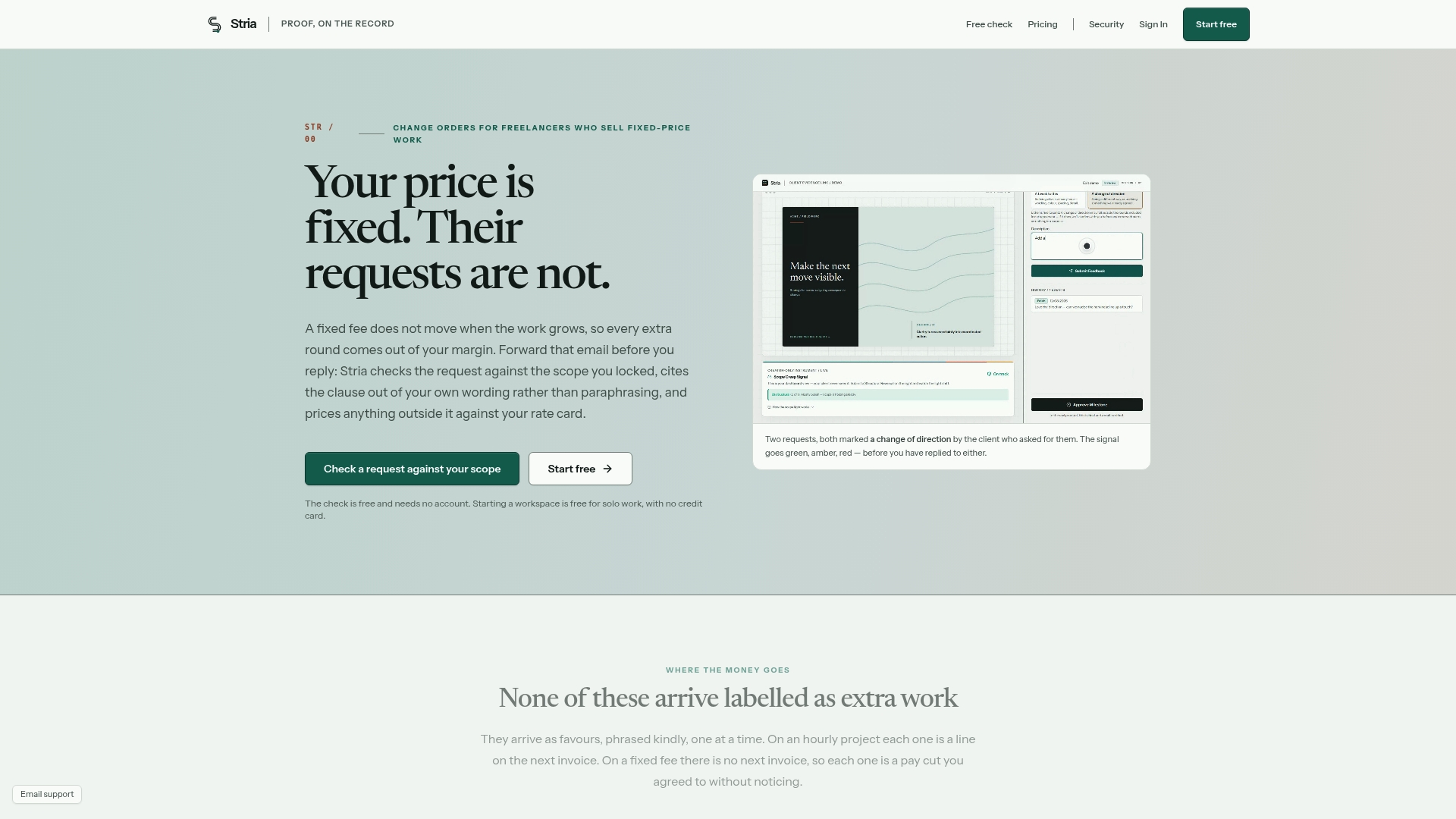
You can see how it works and try it on the Stria landing page, or go straight to plan pricing to compare the Free, Freelancer Solo, Freelancer Studio, and Freelancer Agency plans.
Sources
For definitions and procurement framing, see NIGP's best-practice guidance on scope of work versus statement of work, and PMI's standards on deliverable clarity.
- NIGP: Distinguishing Between Scope of Work and Statement of Work (best practice)
FAQ
What comes first, RFP or SOW?
An RFP, when one exists, comes first, followed by a proposal, vendor selection, and then the SOW. Many freelance engagements skip the RFP entirely and move straight from a conversation to a proposal and then an SOW.
What does SOW mean in a proposal?
Inside a proposal, "SOW" usually refers to a preliminary or example scope of work meant to illustrate the approach, not the final contractual document. The binding SOW is drafted and finalized after the client selects a vendor.
What is the difference between an engagement letter and a SOW?
An engagement letter is common in professional services like accounting or legal work and covers similar ground to an SOW, including scope and fees, but in a lighter, less granular format. An SOW tends to be more detailed, with specific deliverables, milestones, and acceptance criteria.
Is a SOW considered a contract?
An SOW often becomes part of the contract once both parties sign it, either standalone or incorporated into a master services agreement. Because of this, vague deliverable descriptions or missing acceptance criteria in an SOW can create real legal exposure, not just project confusion.